Rodent Surgery/Postop Record Card
Introduction
The IACUC Policy "Rodent Survival Surgery" requires the use of Surgery/Postop Record Cards for rodents undergoing survival surgery that are housed within ULAR facilities and strongly recommends them for satellite locations. Additional training is available free of charge by contacting ULAR's training team (ULARtraining@osu.edu).
General usage
- At the top of the card, record the surgery date, procedure name, and surgeon's initials.
- In the table, record every postop check and each analgesic administration.
- If additional space is needed, use a second card.
- Cards must remain on the cage throughout the postoperative monitoring period, as defined in the IACUC protocol, and until any skin sutures or wound clips are removed.
- If multiple animals within the cage undergo the same procedure, a single card can be used.
- Completed cards must be retained by the research team for at least 6 months and made available during IACUC inspections.
Analgesic administration
- On the analgesics line, list all analgesics administered before, during, and after surgery.
- Extended-release products such as Ethiqa XR must be clearly specified or standard release products are assumed.
- If no analgesics are administered per protocol, write "none."
- When administering NSAID water, add an entry for initiation.
- This should be at least 24 hours prior to surgery (or a loading dose injection given).
- Include the medicated water in the analgesia given box if present during checks.
- Required bottle changes can be recorded on this card or using a separate purple calendar card.
- Ibuprofen (Motrin) water — every 3–4 days
- Carprofen water — every 7 days
- If ULAR administers buprenorphine pre-operatively, ULAR staff will document it on the card.
- The first initial of the drug or an abbreviation can be used in the analgesia given box.
Postoperative monitoring
- Record 5 consecutive daily postop checks, beginning the day after surgery, unless otherwise specified in the IACUC protocol.
- Each postop check must include a clinical score.
- 1 — Normal
- 2 — Abnormal
- 3 — Found dead or euthanized
- If a score of 2 is assigned, note the abnormal observation and course of action on the back of the card. The condition and action taken must be described in the IACUC protocol or the animal must be reported to ULAR veterinary staff for guidance.
- Examples of findings that warrant a score of 2:
- Hunched posture, lethargic, and/or rough coat
- Low body condition or weight loss
- Incisional issues such as dehiscence, swelling, or redness
- If animals in the cage have different clinical scores, list all scores in the box. This could be "2/1" if some animals are normal, but at least one is abnormal.
- Postoperative deficiencies that are expected for the model and described in the protocol do not need to be scored as 2 (e.g., intended mobility issues following a procedure).
Card examples
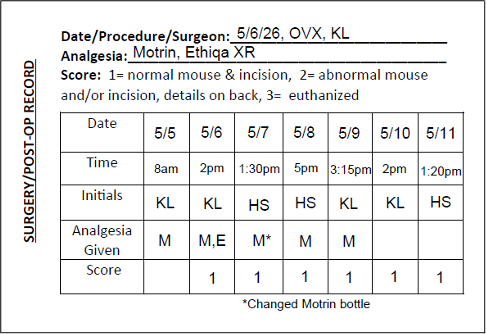
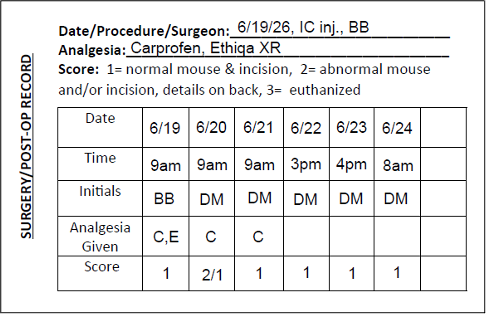
Note on back: 6/20/26 - #4820 partial dehiscence. Contacted ULAR vet staff.
Article ID: 139
Created: June 16, 2026
Last Updated: October 14, 2026
Online URL: https://ohiostateresearch.knowledgebase.co/article/rodent-surgery-postop-record-card-139.html